Showing posts with label Control. Show all posts

Friday, August 30, 2013

Flutter: A phenomenon whereby the elevator or aileron control surface begins to oscillate violently in flight. This can sometimes cause the surface to break away from the aircraft and cause a crash. There are many reasons for this, but the most common are excessive hinge gap or excessive "slop" in the pushrod connections and control horns. If you ever hear a low-pitched buzzing sound, reduce throttle and land immediately.
Flutter (Aircraft Flutter)

Posted on Friday, August 30, 2013 by Rc Pilot

No comments

Wednesday, August 7, 2013

Hinged control surface located at the trailing edge of the wing inboard of the ailerons. The flaps are lowered to produce more aerodynamic lift from the wing, allowing a slower takeoff and landing speed. Flaps are often found on scale models, but usually not on basic trainers.
Flaps


Posted on Wednesday, August 07, 2013 by Rc Pilot

No comments

Sunday, August 4, 2013

Elevator: Hinged control surface located at the trailing edge of the horizontal stabilizer, which provides control of the airplane about the pitch axis and causes the airplane to climb or dive. The correct direction of control is to pull the transmitter elevator control stick back, toward the bottom of the transmitter, to move the elevator upward, which causes the airplane to climb, and vice versa to dive.
Elevator Aircraft
Airplane, Propeller, Aileron, Rudder, Elevator

Posted on Sunday, August 04, 2013 by Rc Pilot

No comments

Saturday, August 3, 2013

Electronic Speed Control (ESC): Electronic speed controls replace the mechanical speed control and servo providing enhanced power efficiency and precision in an electric R/C car, airplane, helicopter or boat. In addition, they are lighter which improves the performance of some electric models.

esc single schematic
Wikipedia:
An electronic speed control or ESC is an electronic circuit with the purpose to vary an electric motor's speed, its direction and possibly also to act as a dynamic brake. ESCs are often used on electrically powered radio controlled models, with the variety most often used for brushless motors essentially providing an electronically-generated three phase electric power low voltage source of energy for the motor.

An ESC can be a stand-alone unit which plugs into the receiver's throttle control channel or incorporated into the receiver itself, as is the case in most toy-grade R/C vehicles. Some R/C manufacturers that install proprietary hobby-grade electronics in their entry-level vehicles, vessels or aircraft use onboard electronics that combine the two on a single circuit board.

Cars
ESCs designed for sport use in cars generally have reversing capability; newer sport controls can have the reversing ability overridden so that it can not be used in a race. Controls designed specifically for racing and even some sport controls have the added advantage of dynamic braking capability. The ESC forces the motor to act as a generator by placing an electrical load across the armature. This in turn makes the armature harder to turn, thus slowing or stopping the model. Some controllers add the benefit of regenerative braking.

Helicopters 
ESCs designed for radio-control helicopters do not require a braking feature (since the one way bearing would render it useless anyhow) nor do they require reverse direction (although it can be helpful since the motor wires can often be difficult to access and change once installed). Many high-end helicopter ESCs provide a "Governor mode" which fixes the motor RPM to a set speed, greatly aiding CCPM-based flight.

Airplanes 
ESCs designed for radio-control airplanes usually contain a few safety features. If the power coming from the battery is insufficient to continue running the electric motor the ESC will reduce or cut off power to the motor while allowing continued use of ailerons, rudder and elevator function. This allows the pilot to retain control of the airplane to glide or fly on low power to safety.

Boats
ESCs designed for boats are by necessity waterproof. Also, many are water-cooled. Like cars, boats need braking and reverse capability.


Posted on Saturday, August 03, 2013 by Rc Pilot

No comments

Wednesday, July 3, 2013

This radio feature permits you to check servo operation without broadcasting a radio signal. A cable connects the transmitter to the receiver. Direct servo control is very useful for on-the-ground control checks.
DSC - Direct Servo Control

Futaba Description:
Direct Servo Control (DSC): High-end convenience feature which allows control/adjustment of servo function without sending signal through receiver. Requires optional DSC cord (FUTM4250) and DSC-compatible receiver such as R149DP and R113IP.

Posted on Wednesday, July 03, 2013 by Rc Pilot

No comments

Friday, June 14, 2013

Dihedral
Image: Dihedral

Dihedral:

The V-shaped bend in the wing. Typically, more dihedral causes more aerodynamic stability in an airplane, and causes the rudder to control both the roll and yaw axis. This is why some trainers and sailplanes require only 3 channels of radio control--i.e., having no ailerons.
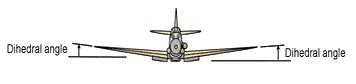
Dihedral Angle
Image: Dihedral Angle

Dihedral Angle

In the illustration above, A and B are two separate planes lying perpendicular to another plane C. The dihedral angle equals zero between planes A and B.

To demonstrate a dihedral angle greater than zero, first let aA and aB equal 90 degrees. Second, let plane B rotate around the line where plane B and C intersect while letting plane A remain perpendicular to C. For example, let aB (the angle where plane B intersects plane C) equal 60 degrees.

The dihedral angle (represented by the symbol J) between A and B now equals 30 degrees. This can also be viewed as the illustration below.

Dehidral Aircraft

Dihedral (Aircraft)

Dihedral angle is the upward angle from horizontal of the wings or tailplane of a fixed-wing aircraft. "Anhedral angle" is the name given to negative dihedral angle, that is, when there is a downward angle from horizontal of the wings or tailplane of a fixed-wing aircraft.

 Schematic of dihedral and anhedral angle of an aircraft wing.

Dihedral angle (or anhedral angle) has a strong influence on dihedral effect, which is named after it. Dihedral effect is the amount of roll moment produced per degree (or radian) of sideslip. Dihedral effect is a critical factor in the stability of an aircraft about the roll axis (the spiral mode). It is also pertinent to the nature of an aircraft's Dutch roll oscillation and to maneuverability about the roll axis.

 Measuring the dihedral angle.

Longitudinal dihedral is a comparatively obscure term related to the pitch axis of an airplane. It is the angle between the zero lift axis of the wing and horizontal tail. Longitudinal dihedral can influence the nature of controllability about the pitch axis and the nature of an aircraft's phugoid-mode oscillation.

When the term "dihedral" (of an aircraft) is used by itself it is usually intended to mean "dihedral angle". However, context may otherwise indicate that "dihedral effect" is the intended meaning.
Anhedral angle
Image: Anhedral angle

Source: Wiki

Posted on Friday, June 14, 2013 by Admin OG

No comments

Sunday, May 12, 2013

Buddy Box
Buddy Box Meaning:
Two similar transmitters that are wired together with a "trainer cord." This is most useful when learning to fly -- it's the same as having dual controls. The instructor can take control by using the "trainer switch" on his transmitter.

Training method utilizing two transmitter control boxes, linked together. The trainer radio has override control, which the instructor uses to take control when the trainee looses control, or becomes disoriented.

Wiki:

Buddy box or buddy boxing is a colloquialism referring to two R/C aircraft radio systems joined together for pilot training purposes.

This training system is universal among the five major R/C radio manufacturers (Futaba, JR, Hitec, Airtronics and KO Propo) which means that transmitters do not have to be the same brand in order to be joined via an umbilical cable. There are, however, two different types of DIN cable connectors used for the purpose and the two are incompatible. Therefore, both transmitters must have the same type of receptacle in order to operate together.

Buddy Box Bidding

Buddy boxing is accomplished by joining the student and master transmitters via the aforementioned cable and making sure that the servo reversing switches and trims are set identical on both. The student is given control of the aircraft via a long-handled, spring-loaded switch on the top left corner of most transmitters located on the master transmitter, normally held by the instructor. When the switch is pulled forward and held on by the instructor's left index finger, control of the aircraft is at the student's transmitter. Should the instructor judge that the student is encountering difficulty in flight, control is transferred to the master transmitter merely by releasing the switch. (On some older Futaba radios such as the popular 6XA, the trainer switch is actually a push-button located in the corner, the aforementioned corner toggle switch is reserved for channel 5 - landing gear.)

The two transmitters need not be on the same frequency. The master transmitter is the one that actually flies the plane; buddy boxing turns the student transmitter into a "dummy" remote control of the master. The student transmitter is operated with power switched off as power for both is provided by the master. The student transmitter will power up via the umbilical despite being switched off.

Posted on Sunday, May 12, 2013 by Admin OG

1 comment