Friday, July 5, 2013

Electric vs. Gas Cars: Electric vehicles are the most popular choice in R/C car racing. They are quick, quiet, easy to build and comfortable for the beginning R/Cer to drive. The electric cars are powered with a rechargeable nicd battery that can be charged in as little as 15-20 minutes. A vehicle with a stock motor will provide about 6-8 minutes of run time; with a couple of batteries and a 15 minute charger, an electric car or truck is ready for hours of use. The popularity of Gas vehicles has increased tremendously over the last few years. The explosive power and acceleration of a gas powered car or truck is exciting to watch. Gas vehicles are powered by a small two-cycle engine burning glow fuel (not gasoline!), and many modelers enjoy the realistic sound and smell that goes along with gas powered racing. Some gas models can reach speeds over 50mph! The wider availability of pull-start engines and the new wave of 1/10 scale vehicles has made it much more affordable for the beginner to enter gas-powered racing.
Electric vs. Gas Cars

Posted on Friday, July 05, 2013 by Rc Pilot

No comments

Thursday, July 4, 2013

Down Thrust: Downward angle of the engine relative to the centerline of the airplane. Down thrust helps overcome the normal climbing tendency of flat bottom wings.
Down Thrust


Posted on Thursday, July 04, 2013 by Rc Pilot

No comments

Wednesday, July 3, 2013

Minor dent or damage to the structure. Also, a nick in a prop. Dinged props must be replaced.

Posted on Wednesday, July 03, 2013 by Rc Pilot

No comments

This radio feature permits you to check servo operation without broadcasting a radio signal. A cable connects the transmitter to the receiver. Direct servo control is very useful for on-the-ground control checks.
DSC - Direct Servo Control

Futaba Description:
Direct Servo Control (DSC): High-end convenience feature which allows control/adjustment of servo function without sending signal through receiver. Requires optional DSC cord (FUTM4250) and DSC-compatible receiver such as R149DP and R113IP.

Posted on Wednesday, July 03, 2013 by Rc Pilot

No comments

Tuesday, July 2, 2013

T-REX 100X Super Combo KX022005A Rc Helicopter

T-REX 100X Super Combo KX022005A Rc Helicopter

Introduction:

  • Fun and easy flying characteristic has been the reason for T-Rex 100S’s unparallel popularity. To increase its performance even further, Align has improved upon the T-Rex 100S and introduces the brand new T-Rex 100X.
  • To improve the flight stability and shorter learning curve, rotor head assembly features a new mounting method between rotor head and main shaft, and the surface area of flybar paddle has been increased. In addition to interchangeable stick mode on the transmitter, stick tension is also adjustable. Transmitter also feature gyro gain adjustment for simple tail sensitivity tuning.
  • But the most unique feature is that T-Rex 100X can also be controlled through an iPhone, allowing pilot to experience a completely different flying method.
  • Superior flight stability and quality assurance, for immediate indoor flying gratification, T-Rex 100X is the prime choice for any pilot!


Features:

  • Brand new rotor head to main shaft attachment design, improving flight stability and minimize vibration.
  • Transmitter sticks’ tension can be adjusted to suit pilot’s preference.
  • High contrast LCD display screen.
  • Extended tailboom to improve gyro tail locking ability and overall controllability.
  • Remote gyro gain adjustment on transmitter for ease of tail tuning.
  • Supports iPhone/Android as controller using specific transmitter attachment.
  • Brand new canopy design.
  • Utilizes AFHDS 2.4Ghz automatic frequency hopping technology for stable signal and interference avoidance.
  • Transmitter has trainer port capable of interfacing with third party flight simulators on PC. Interface cable is included.
  • Support mode 1, 2, and 3 transmitter stick layout.
  • Increased flybar paddle to effectively increase flight stability.
  • Utilizes hobby grade micro servos and increased frame rigidity, for flight stability, crash survivability, and longevity.
  • Built in Nimh and Lipo battery charger which can be used while flying.
  • Convenient USB charging jack allowing universal compatibility with PC’s USB port, or any 5v USB travel charger to charge transmitter’s Nimh battery.
  • Charging status and capacity display.
  • 5-in-1 circuitry includes receiver, ESC, heading lock gyro, servos, and mixing function.

Users must have a certain concept of security to operate the R/C helicopters.
Be sure to read and comply with related safety notes of instruction manual before flying.

Focus Shot 1(High precision head assembly and the surface area of flybar paddle increased)
High precision head assembly and the surface area of flybar paddle increased

Focus Shot 2(Rotor head assembly features a new mounting method between rotor head and main shaft )
Rotor head assembly features a new mounting method between rotor head and main shaft

Focus Shot 3(Utilizes hobby grade micro servos and high efficiency coreless main motor)
Utilizes hobby grade micro servos and high efficiency coreless main motor

Focus Shot 4(Extended tailboom to improve gyro tail locking ability and overall controllability)
Extended tailboom to improve gyro tail locking ability and overall controllability

Focus Shot 5(High efficiency coreless tail motor)
High efficiency coreless tail motorr

Focus Shot 6(Supports iPhone/Android as controller using specific transmitter attachment)
Supports iPhone/Android as controller using specific transmitter attachmen

Focus Shot 7(AT 100 Transmitter support 3 mode)
AT 100 Transmitter support 3 mode

Focus Shot 8(Transmitter sticks’ tension can be adjusted to suit pilot’s preference )
Transmitter sticks’ tension can be adjusted to suit pilot’s preference

Focus Shot 9(High contrast LCD display screen )
High contrast LCD display screen

Focus Shot 10(Remote gyro gain adjustment on transmitter for ease of tail tuning)
Remote gyro gain adjustment on transmitter for ease of tail tuning

Focus Shot 11(Brand new canopy design)
Brand new canopy design

Focus Shot 12(1.2V / 1600mAh Ni-MH Chargeable Battery)
1.2V / 1600mAh Ni-MH Chargeable Battery

Focus Shot 13(3.7V / 150mAh Li-Polymer Battery )
3.7V / 150mAh Li-Polymer Battery

Focus Shot 14(CD-ROM)
CD/DVD ROM

Focus Shot 15(CH100 Lipo Charger )
CH100 Lipo Charger

Focus Shot 16(USB Cable )
USB Cable

Focus Shot 17(Simulator Cable)
Simulator Cable

Focus Shot 18(Philips Screwdriver PH00)
Philips Screwdriver PH00

Illustration:(Optional:Supports iPhone/Android as controller using specific transmitter attachment)
Optional:Supports iPhone/Android as controller using specific transmitter attachment

Illustration:(Compatible with Flight Simulator)
Compatible with Flight Simulator

Illustration:(Charging method for transmitter's Ni-MH batteries)
Charging method for transmitter's Ni-MH batteries

Illustration:(Using the charging receptacle on transmitter to charge helicopter battery)
Using the charging receptacle on transmitter to charge helicopter battery

Illustration:(Using the CH100 Li-Po charger to charge helicopter battery)
Using the CH100 Li-Po charger to charge helicopter battery

Specification:
Length: 209mm
Height: 82mm
Main Rotor Diameter: 192mm
Tail Rotor Diameter: 36mm
Weight(w/o power system): 28.8g
Flying Weight: Approx 33g

Posted on Tuesday, July 02, 2013 by Rc Pilot

No comments

Friday, June 14, 2013

Dihedral
Image: Dihedral

Dihedral:

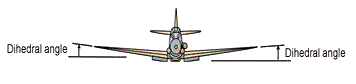
The V-shaped bend in the wing. Typically, more dihedral causes more aerodynamic stability in an airplane, and causes the rudder to control both the roll and yaw axis. This is why some trainers and sailplanes require only 3 channels of radio control--i.e., having no ailerons.
Dihedral Angle
Image: Dihedral Angle

Dihedral Angle

In the illustration above, A and B are two separate planes lying perpendicular to another plane C. The dihedral angle equals zero between planes A and B.

To demonstrate a dihedral angle greater than zero, first let aA and aB equal 90 degrees. Second, let plane B rotate around the line where plane B and C intersect while letting plane A remain perpendicular to C. For example, let aB (the angle where plane B intersects plane C) equal 60 degrees.

The dihedral angle (represented by the symbol J) between A and B now equals 30 degrees. This can also be viewed as the illustration below.

Dehidral Aircraft

Dihedral (Aircraft)

Dihedral angle is the upward angle from horizontal of the wings or tailplane of a fixed-wing aircraft. "Anhedral angle" is the name given to negative dihedral angle, that is, when there is a downward angle from horizontal of the wings or tailplane of a fixed-wing aircraft.

 Schematic of dihedral and anhedral angle of an aircraft wing.

Dihedral angle (or anhedral angle) has a strong influence on dihedral effect, which is named after it. Dihedral effect is the amount of roll moment produced per degree (or radian) of sideslip. Dihedral effect is a critical factor in the stability of an aircraft about the roll axis (the spiral mode). It is also pertinent to the nature of an aircraft's Dutch roll oscillation and to maneuverability about the roll axis.

 Measuring the dihedral angle.

Longitudinal dihedral is a comparatively obscure term related to the pitch axis of an airplane. It is the angle between the zero lift axis of the wing and horizontal tail. Longitudinal dihedral can influence the nature of controllability about the pitch axis and the nature of an aircraft's phugoid-mode oscillation.

When the term "dihedral" (of an aircraft) is used by itself it is usually intended to mean "dihedral angle". However, context may otherwise indicate that "dihedral effect" is the intended meaning.
Anhedral angle
Image: Anhedral angle

Source: Wiki

Posted on Friday, June 14, 2013 by Admin OG

No comments

Thursday, June 13, 2013


Teaser for my new 45 minute video called "Dead Stick Takeoff Flying Adventures"

Posted on Thursday, June 13, 2013 by Admin OG

No comments


Differential Throw Ailerons
Ailerons that are set up to deflect more in the upward direction than downward are said to have Differential Throw. The purpose is to counteract Adverse Yaw.


Radio controlled aircraft with ailerons can benefit from differential throws of ailerons. Aileron differential means that the aileron that moves upward needs to be deflected by a larger angle, and the one that moves downward is being deflected by a smaller angle. This results in a more coordinated roll of the aircraft because if the aileron throws were the same, the equal angle of downward deflection causes more drag than lift for the upward moving wing, slowing the wing down and causing the aircraft to yaw in the direction opposite to the desired direction of turn (if any).
     While desirable, differential aileron throws is not really a critical flight function and is not implemented in many lower-cost computer radios. And, of course, it is not at all available in simple, non-computer radios. And if you sensibly choose to drive both ailerons with one servo then transmitter programming is of no use at all.
     There is a simple way of accomplishing differential aileron throws mechanically, by positioning control horns away from the hinge of the control surface. On this page we provide simple charts that allow one to measure and position aileron control horns to get precise maximum throw angles while achieving the desired differential.

To use the charts, first make a note of the deflection angle you need and of what percentage of the upward deflection angle you want the downward deflection angle to be (the differential). Next critical parameter is servo arm travel. This parameter is what you can change by placing the aileron linkage in the different holes in the servo arm.
 Next, follow the links in the table below to find the servo arm travel that will enable you to select the horn offset and clevis height, while giving the desired deflection angle and percentage of differential. Make sure that you use charts for the same servo arm travel.
Source: http://www.rcmix.com/diff_ailerons.html

Posted on Thursday, June 13, 2013 by Admin OG

No comments

Airplane Dead

A term used to describe unpowered flight (glide) when the engine quits running.

With the engine quiet and the plane ready for takeoff, Steve coaxes the Highlander into flight. The plane gains speed as it coasts down a steep hill and before long it is airborne. Now gliding through the air, the engine remains off; Steve brings the plane in, landing it just as he took off: completely deadstick. The shear excitement and joy from this maneuver is contagious. Not only do you easily feel Steve’s enthusiasm for the feat he is performing,
but you also feel his love for the air and for his plane. Without the Highlander this would be nearly impossible.  However, due to the unique qualities of the plane, Steve was able to master this act and share his joy with the world.
Dead Stick

Posted on Thursday, June 13, 2013 by Admin OG

No comments