Flutter: A phenomenon whereby the elevator or aileron control surface begins to oscillate violently in flight. This can sometimes cause the surface to break away from the aircraft and cause a crash. There are many reasons for this, but the most common are excessive hinge gap or excessive "slop" in the pushrod connections and control horns. If you ever hear a low-pitched buzzing sound, reduce throttle and land immediately.
Showing posts with label Aircraft. Show all posts
Friday, August 30, 2013
Wednesday, August 7, 2013
Posted on Wednesday, August 07, 2013 by Rc Pilot
Tuesday, August 6, 2013
Epoxy : A two-part resin/hardener glue that is extremely strong. It is generally available in 6 and 30-minute formulas. Used for critical points in the aircraft where high strength is necessary.
Wikipedia Epoxy:
Epoxy is both the basic component and the cured end product of epoxy resins, as well as a colloquial name for the epoxide functional group. Epoxy resins, also known as polyepoxides are a class of reactive prepolymers and polymers which contain epoxide groups. Epoxy resins may be reacted (cross-linked) either with themselves through catalytic homopolymerisation, or with a wide range of co-reactants including polyfunctional amines, acids (and acid anhydrides), phenols, alcohols, and thiols. These co-reactants are often referred to as hardeners or curatives, and the cross-linking reaction is commonly referred to as curing. Reaction of polyepoxides with themselves or with polyfunctional hardeners forms a thermosetting polymer, often with strong mechanical properties as well as high temperature and chemical resistance. Epoxy has a wide range of applications, including metal coatings, use in electronics / electrical components, high tension electrical insulators, fiber-reinforced plastic materials, and structural adhesives. Epoxy resin is employed to bind gutta percha in some root canal procedures.
Wikipedia Epoxy:
Epoxy is both the basic component and the cured end product of epoxy resins, as well as a colloquial name for the epoxide functional group. Epoxy resins, also known as polyepoxides are a class of reactive prepolymers and polymers which contain epoxide groups. Epoxy resins may be reacted (cross-linked) either with themselves through catalytic homopolymerisation, or with a wide range of co-reactants including polyfunctional amines, acids (and acid anhydrides), phenols, alcohols, and thiols. These co-reactants are often referred to as hardeners or curatives, and the cross-linking reaction is commonly referred to as curing. Reaction of polyepoxides with themselves or with polyfunctional hardeners forms a thermosetting polymer, often with strong mechanical properties as well as high temperature and chemical resistance. Epoxy has a wide range of applications, including metal coatings, use in electronics / electrical components, high tension electrical insulators, fiber-reinforced plastic materials, and structural adhesives. Epoxy resin is employed to bind gutta percha in some root canal procedures.
Posted on Tuesday, August 06, 2013 by Rc Pilot
Sunday, August 4, 2013
Elevator: Hinged control surface located at the trailing edge of the horizontal stabilizer, which provides control of the airplane about the pitch axis and causes the airplane to climb or dive. The correct direction of control is to pull the transmitter elevator control stick back, toward the bottom of the transmitter, to move the elevator upward, which causes the airplane to climb, and vice versa to dive.
Posted on Sunday, August 04, 2013 by Rc Pilot
Friday, June 14, 2013
![]() |
| Image: Dihedral |
Dihedral:
The V-shaped bend in the wing. Typically, more dihedral causes more aerodynamic stability in an airplane, and causes the rudder to control both the roll and yaw axis. This is why some trainers and sailplanes require only 3 channels of radio control--i.e., having no ailerons.![]() |
| Image: Dihedral Angle |
Dihedral Angle
In the illustration above, A and B are two separate planes lying perpendicular to another plane C. The dihedral angle equals zero between planes A and B.To demonstrate a dihedral angle greater than zero, first let aA and aB equal 90 degrees. Second, let plane B rotate around the line where plane B and C intersect while letting plane A remain perpendicular to C. For example, let aB (the angle where plane B intersects plane C) equal 60 degrees.
The dihedral angle (represented by the symbol J) between A and B now equals 30 degrees. This can also be viewed as the illustration below.
Dihedral (Aircraft)
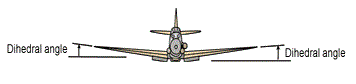
Dihedral angle is the upward angle from horizontal of the wings or tailplane of a fixed-wing aircraft. "Anhedral angle" is the name given to negative dihedral angle, that is, when there is a downward angle from horizontal of the wings or tailplane of a fixed-wing aircraft.Schematic of dihedral and anhedral angle of an aircraft wing.
Dihedral angle (or anhedral angle) has a strong influence on dihedral effect, which is named after it. Dihedral effect is the amount of roll moment produced per degree (or radian) of sideslip. Dihedral effect is a critical factor in the stability of an aircraft about the roll axis (the spiral mode). It is also pertinent to the nature of an aircraft's Dutch roll oscillation and to maneuverability about the roll axis.
Measuring the dihedral angle.
Longitudinal dihedral is a comparatively obscure term related to the pitch axis of an airplane. It is the angle between the zero lift axis of the wing and horizontal tail. Longitudinal dihedral can influence the nature of controllability about the pitch axis and the nature of an aircraft's phugoid-mode oscillation.
When the term "dihedral" (of an aircraft) is used by itself it is usually intended to mean "dihedral angle". However, context may otherwise indicate that "dihedral effect" is the intended meaning.
![]() |
| Image: Anhedral angle |
Source: Wiki
Posted on Friday, June 14, 2013 by Admin OG
Tuesday, June 11, 2013
A weighted fuel pick-up used in a fuel tank to assure the intake line is always in fuel.
The Nitro Fuel Tank Clunk
For those of you in the RC airplane world this is nothing new, but it might be a new term or idea for those of you with nitro RC cars, truck, or boats.
RC aircraft fly in many different attitudes – meaning pointing up, pointing down, on their sides, and upside down... not to mention the high G forces pulling the fuel to one side of the tank or the other.
If the fuel pick up was at a fixed location in the tank – say the lowest part of the tank like in a car – the air craft would only get fuel when it is flying straight and level. Any banking or inverted flying would starve the engine of nitro fuel.
A very simple solution of using a short length of fuel tubing inside the fuel tank with a heavy weight at the end of the tube called a "CLUNK" ensures no fuel starvation. This tube and clunk will simply flop around inside the fuel tank which ever way gravity pulls on it - just like the fuel in the tank. This means no mater what the RC aircraft is doing, the pick up end of the fuel tube in the tank is always submerged in fuel.
This clunk, more specifically the fuel tube it is hooked up to inside the fuel tank should be checked for deterioration every year or so. The tube over the years will get brittle and may crack or come off the supply tube in your fuel tank. This of course means you now have a fixed nitro fuel pick-up and all the benefits of the clunk are lost.
Posted on Tuesday, June 11, 2013 by Admin OG
Monday, May 20, 2013
CG ("Center of Gravity"):
For modeling purposes, this is usually considered -- the point at which the airplane balances fore to aft. This point is critical in regards to how the airplane reacts in the air. A tail-heavy plane will be very snappy but generally very unstable and susceptible to more frequent stalls. If the airplane is nose heavy, it will tend to track better and be less sensitive to control inputs, but, will generally drop its nose when the throttle is reduced to idle. This makes the plane more difficult to land since it takes more effort to hold the nose up. A nose heavy airplane will have to come in faster to land safely.
Posted on Monday, May 20, 2013 by Admin OG
Subscribe to:
Posts (Atom)
Categories
- Battery (5)
- Cars (3)
- Engine (5)
- Heli (2)
- Rc Dictionary (44)
- Rc-Helicopter (2)
- Trucks (2)
Popular Posts
-
The angle that the wing penetrates the air. As the angle of attack increases so does lift and drag , up to a point .
-
Image: Dihedral Dihedral: The V-shaped bend in the wing. Typically, more dihedral causes more aerodynamic stability in an airplane, ...
-
A 2.4GHz radio system which selects one (or two) of the available " free " frequencies and transmits only on the one(s) chosen....
-
Flutter: A phenomenon whereby the elevator or aileron control surface begins to oscillate violently in flight . This can sometimes cause th...
-
Buddy Box Meaning: Two similar transmitters that are wired together with a " trainer cord ." This is most useful when learning ...
-
Epoxy : A two-part resin/hardener glue that is extremely strong. It is generally available in 6 and 30-minute formulas . Used for critical...
-
The tendency of an airplane to yaw in the opposite direction of the roll. For instance, when right aileron is applied, the airplane yaws t...
-
A hand-held stick used to "flip start" a model airplane engine . The Hobbico Safe Start " chicken stick " is a saf...
-
Flight Box : A special box used to hold and transport all equipment used at the flying field. Flight Box
-
Hinged control surface located at the trailing edge of the wing inboard of the ailerons. The flaps are lowered to produce more aerodynamic...