Showing posts with label Airplane. Show all posts

Thursday, August 8, 2013

Flare, the point during the landing approach in which the pilot gives an increased amount of up elevator to smooth the touchdown of the airplane.


Posted on Thursday, August 08, 2013 by Rc Pilot

No comments

Wednesday, August 7, 2013

Hinged control surface located at the trailing edge of the wing inboard of the ailerons. The flaps are lowered to produce more aerodynamic lift from the wing, allowing a slower takeoff and landing speed. Flaps are often found on scale models, but usually not on basic trainers.
Flaps


Posted on Wednesday, August 07, 2013 by Rc Pilot

No comments

Sunday, August 4, 2013

Elevator: Hinged control surface located at the trailing edge of the horizontal stabilizer, which provides control of the airplane about the pitch axis and causes the airplane to climb or dive. The correct direction of control is to pull the transmitter elevator control stick back, toward the bottom of the transmitter, to move the elevator upward, which causes the airplane to climb, and vice versa to dive.
Elevator Aircraft
Airplane, Propeller, Aileron, Rudder, Elevator

Posted on Sunday, August 04, 2013 by Rc Pilot

No comments

Thursday, July 25, 2013

Flight Pack or Airborne Pack : All of the radio equipment installed in the airplane, i.e., Receiver, Servos, Battery, Switch Harness.
This is not a similar thing to the flight box, rather it refers to all the radio equipment that is used in an RC aircraft during flight. This includes most importantly the receiver, but also the servos/ESC, flight pack battery/BEC and the harness. The transmitter is outwith the craft and so not considered part of the flight pack, despite its involvement.
Flight Pack  Airborne Pack

Posted on Thursday, July 25, 2013 by Rc Pilot

No comments

Thursday, July 4, 2013

Down Thrust: Downward angle of the engine relative to the centerline of the airplane. Down thrust helps overcome the normal climbing tendency of flat bottom wings.
Down Thrust


Posted on Thursday, July 04, 2013 by Rc Pilot

No comments

Friday, June 14, 2013

Dihedral
Image: Dihedral

Dihedral:

The V-shaped bend in the wing. Typically, more dihedral causes more aerodynamic stability in an airplane, and causes the rudder to control both the roll and yaw axis. This is why some trainers and sailplanes require only 3 channels of radio control--i.e., having no ailerons.
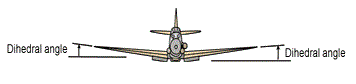
Dihedral Angle
Image: Dihedral Angle

Dihedral Angle

In the illustration above, A and B are two separate planes lying perpendicular to another plane C. The dihedral angle equals zero between planes A and B.

To demonstrate a dihedral angle greater than zero, first let aA and aB equal 90 degrees. Second, let plane B rotate around the line where plane B and C intersect while letting plane A remain perpendicular to C. For example, let aB (the angle where plane B intersects plane C) equal 60 degrees.

The dihedral angle (represented by the symbol J) between A and B now equals 30 degrees. This can also be viewed as the illustration below.

Dehidral Aircraft

Dihedral (Aircraft)

Dihedral angle is the upward angle from horizontal of the wings or tailplane of a fixed-wing aircraft. "Anhedral angle" is the name given to negative dihedral angle, that is, when there is a downward angle from horizontal of the wings or tailplane of a fixed-wing aircraft.

 Schematic of dihedral and anhedral angle of an aircraft wing.

Dihedral angle (or anhedral angle) has a strong influence on dihedral effect, which is named after it. Dihedral effect is the amount of roll moment produced per degree (or radian) of sideslip. Dihedral effect is a critical factor in the stability of an aircraft about the roll axis (the spiral mode). It is also pertinent to the nature of an aircraft's Dutch roll oscillation and to maneuverability about the roll axis.

 Measuring the dihedral angle.

Longitudinal dihedral is a comparatively obscure term related to the pitch axis of an airplane. It is the angle between the zero lift axis of the wing and horizontal tail. Longitudinal dihedral can influence the nature of controllability about the pitch axis and the nature of an aircraft's phugoid-mode oscillation.

When the term "dihedral" (of an aircraft) is used by itself it is usually intended to mean "dihedral angle". However, context may otherwise indicate that "dihedral effect" is the intended meaning.
Anhedral angle
Image: Anhedral angle

Source: Wiki

Posted on Friday, June 14, 2013 by Admin OG

No comments

Tuesday, June 11, 2013

Chicken Stick, Airplane Engine Start

A hand-held stick used to "flip start" a model airplane engine.

The Hobbico Safe Start "chicken stick" is a safe, easy way to Flip-Start Glow Powered Engines. This stick is held in your hand and with the extended end placed against the propeller on the engine. Then with a quick flip of the wrist to rotate the prop, starting the engine.
Start-R-Stik Standard Large by Davis Diesel Development


Posted on Tuesday, June 11, 2013 by Admin OG

No comments

Monday, May 20, 2013

CG (Center of Gravity)
CG ("Center of Gravity"): For modeling purposes, this is usually considered -- the point at which the airplane balances fore to aft. This point is critical in regards to how the airplane reacts in the air. A tail-heavy plane will be very snappy but generally very unstable and susceptible to more frequent stalls. If the airplane is nose heavy, it will tend to track better and be less sensitive to control inputs, but, will generally drop its nose when the throttle is reduced to idle. This makes the plane more difficult to land since it takes more effort to hold the nose up. A nose heavy airplane will have to come in faster to land safely.

Posted on Monday, May 20, 2013 by Admin OG

No comments

Friday, May 10, 2013

Boring Holes in the Sky : Having fun flying an RC airplane, without any predetermined flight pattern.

Posted on Friday, May 10, 2013 by Admin OG

No comments